

Hello to all, welcome to therichpost.com. In this post, I will tell you, Angular 10 Datatable Working Example.
Angular 10 has just launched and it is in very high in demand. Angular 10 increased his performance speed. I am showing the data in Datatables with custom json data and also for giving good look to datatable, I have used bootstrap in it, here is the working picture and don’t forget to install latest node version.
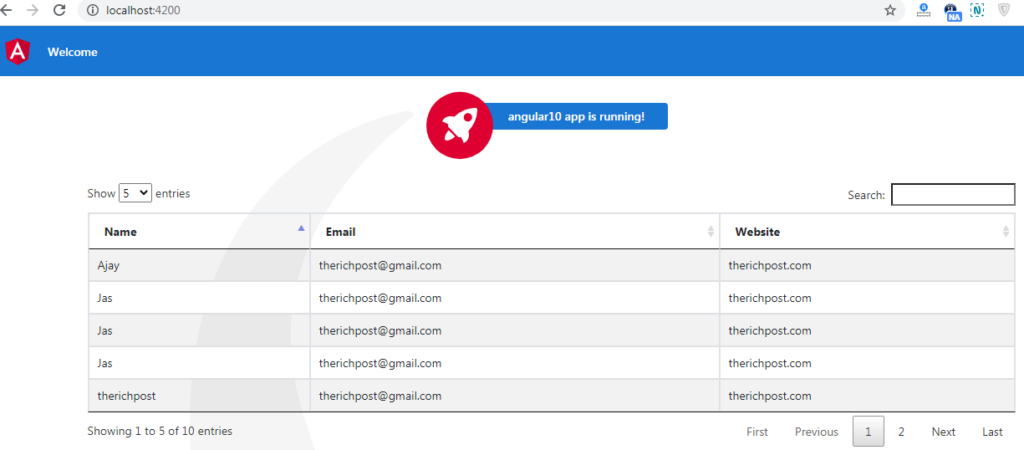
Here is the complete working code and use this carefully:
1. Here are the basics commands, you need to run for latest angular 10 setup and environment:
$ npm install -g @angular/cli

$ ng new angulardatatables

$ cd angulardatatables

$ ng serve

//Here is the url, you need to run into your browser and see working angular test project
http://localhost:4200/
2. Here are the basics commands, you need to run into your terminal for datatable and its dependencies:
I am also adding bootstrap to make datatable looks good
npm install jquery --save

npm install datatables.net --save

npm install datatables.net-dt --save

npm install angular-datatables --save

npm install @types/jquery --save-dev

npm install @types/datatables.net --save-dev

npm install bootstrap --save
3. After done with commands add below code into you angular.json file:
...
"styles": [
              "src/styles.css",
              "node_modules/datatables.net-dt/css/jquery.dataTables.css",
              "node_modules/bootstrap/dist/css/bootstrap.min.css",
            ],
            "scripts": [
            "node_modules/jquery/dist/jquery.js",
            "node_modules/datatables.net/js/jquery.dataTables.js",
            "node_modules/bootstrap/dist/js/bootstrap.js",
            ]
...
4. Now add below code into your app.module.ts file:
...
import {DataTablesModule} from 'angular-datatables';
...
imports: [
...
DataTablesModule
]
5. Now add below code into app.component.ts file:
...
export class AppComponent {
...
public data = [
    {name: 'Ajay', email: 'therichpost@gmail.com', website:'therichpost.com'},
    {name: 'Jas', email: 'therichpost@gmail.com', website:'therichpost.com'},
    {name: 'therichpost', email: 'therichpost@gmail.com', website:'therichpost.com'},
    {name: 'therichpost', email: 'therichpost@gmail.com', website:'therichpost.com'},
    {name: 'Jas', email: 'therichpost@gmail.com', website:'therichpost.com'},
    {name: 'therichpost', email: 'therichpost@gmail.com', website:'therichpost.com'},
    {name: 'therichpost', email: 'therichpost@gmail.com', website:'therichpost.com'},
    {name: 'Jas', email: 'therichpost@gmail.com', website:'therichpost.com'},
    {name: 'therichpost', email: 'therichpost@gmail.com', website:'therichpost.com'},
    {name: 'therichpost', email: 'therichpost@gmail.com', website:'therichpost.com'},
  ];
dtOptions: any = {};
ngOnInit(){
setTimeout(()=>{
  this.dtOptions = {
      pagingType: 'full_numbers',
      pageLength: 5,
    lengthMenu : [5, 10, 25],
      processing: true
    };
}, 100);
}
}
6. Now add below code into app.component.html file:
<table class="table table-striped table-bordered table-sm row-border hover" datatable [dtOptions]="dtOptions">
  <thead>
    <tr>
      <th>Name</th>
      <th>Email</th>
      <th>Website</th>
    </tr>
  </thead>
  <tbody>
   <tr *ngFor="let group of data">
         <td>{{group.name}}</td>
         <td>{{group.email}}</td>
         <td>{{group.website}}</td>
     </tr>
  </tbody>
</table>
Don’t forget to run ng serve command to see final output and if you have any kind of query the please do comment below.
Jassa Jatt
Thank you


Leave a Reply